
VexaHub - Authentication & Key Material Reference
Status: (Draft) Proposed
This document covers the authentication system: the OPAQUE protocol, what gets created at registration, what gets reconstructed at login, and how sessions are managed.
For the full cryptographic specification see the master crypto spec.
Table of Contents
- Authentication Overview
- OPAQUE Protocol
- Registration
- Login
- Session Management
- Account Recovery
- Key Material Quick Reference
1. Authentication Overview
VexaHub uses OPAQUE (RFC 9807) as its password-authenticated key exchange. OPAQUE is a zero-knowledge protocol: the server never sees the user's password, not even a hash of it. Instead, the password is used client-side to participate in an Oblivious Pseudo-Random Function (OPRF) with the server, producing a stable exportKey that only the correct password can derive.
This exportKey is the root of all client-side key material for a session. The server stores only an opaque registration envelope.
It cannot perform offline dictionary attacks even with full database access.
Why OPAQUE instead of SRP or bcrypt?
With standard password hashing (e.g. bcrypt or Argon2id on the server), if the database is compromised, an attacker obtains password hashes and can perform offline brute-force attacks. The cost is bounded only by the hash parameters (memory/time), which helps but does not prevent large-scale guessing.
Argon2id does support additional inputs (like a secret pepper), which can improve security if it is stored separately. However, this shifts the problem to protecting that server-side secret. If both the database and the secret are compromised, offline attacks become possible again.
SRP (RFC 2945) improves on this by avoiding sending the password directly and resisting passive eavesdropping, but it still stores a password-derived verifier. If the verifier database is stolen, attackers can mount offline dictionary attacks against it.
OPAQUE (RFC 9807) goes further. It uses an OPRF (Oblivious Pseudorandom Function) so that the server never sees the raw password or a directly usable verifier. The stored data is hardened by a server-side secret key (serverSetup). Without that key, a database dump alone is not sufficient to test password guesses offline.
OPAQUE is also designed to resist pre-computation attacks and to hide the password even during registration, while providing forward secrecy.
That said, if both the server's secret key and the database are compromised, OPAQUE falls back to the security level of a strong password hashing scheme. Its main advantage is defense-in-depth: it removes the single point of failure where a database leak alone enables offline cracking.
For a zero-knowledge, end-to-end encrypted cloud storage system, this property is especially important. The server cannot efficiently test password guesses or craft responses that help it learn the user's password-derived key material. This reduces the risk of active or offline attacks by the server itself and better aligns with a "zero knowledge" design, where the server should not be able to derive or recover user encryption keys.
Ciphersuite (frozen at protocol version 1)
| Parameter | Value |
|---|---|
| OPRF group | Ristretto255 |
| KE group | Ristretto255 |
| Hash | SHA-512 |
| Key exchange | TripleDhKem (Triple DH + ML-KEM-768 hybrid) |
| Key stretching | Argon2id (m=128 MiB, t=3, p=4) |
The TripleDhKem variant augments standard OPAQUE 3DH with a post-quantum KEM hop. During KE1 the client generates an ephemeral ML-KEM-768 keypair and sends the encapsulation key alongside the DH ephemeral. In KE2 the server encapsulates to the client's ML-KEM-768 key. Both parties mix the ML-KEM shared secret into the key schedule alongside the three DH products. The result: session keys are quantum-resistant. An attacker recording login transcripts today cannot recover session keys with a future cryptographically-relevant quantum computer (CRQC). The OPRF itself remains classical Ristretto255.
serverSetup
At first deployment the server generates a one-time serverSetup blob containing the OPRF secret key (the global pepper) and the server's static AKE keypair. This blob:
- Is loaded via the
OPAQUE_SERVER_SETUPenvironment variable only. - Is never committed to Git, never logged, never returned in any API response.
- Must be backed up encrypted in at least two independent locations.
- If lost, all user accounts are permanently unrecoverable.
Loss of serverSetup = permanent loss of all user accounts.
Server static public key pinning
Every client hardcodes the server's static public key at build time (derived from serverSetup). On every OPAQUE flow completion the client compares the received serverStaticPublicKey against this pinned value. A mismatch aborts the flow immediately and surfaces a security warning. This defends against a substituted server.
2. OPAQUE Protocol
OPAQUE produces two outputs from a successful exchange:
exportKey(64 bytes) client-only, stable across every login for the same password. Never sent to the server. The root from whichmasterKeyWrapperis derived.sessionKey(64 bytes) negotiated with the server and used to mint the API session cookie. The server derives the cookie token from this; the rawsessionKeyis zeroized afterward.
Both are derived from the password + OPRF interaction and the three-DH key exchange. Neither can be reconstructed without the correct password and the server's serverSetup.
3. Registration
Registration is the only time most permanent key material is generated. Everything created here is either stored server-side in wrapped (encrypted) form, or shown once to the user (recovery phrase) and then discarded.
3.1 Full Registration Flow
See diagram in the rendered documentation.
Steps: user input -> OPAQUE exchange -> pin verification -> key generation (
masterKey, X-Wing, ML-DSA-65) -> blob wrapping (VXWM,VXSK,VXRM) -> recovery phrase confirmation ->POST /register/finish-> zeroize.
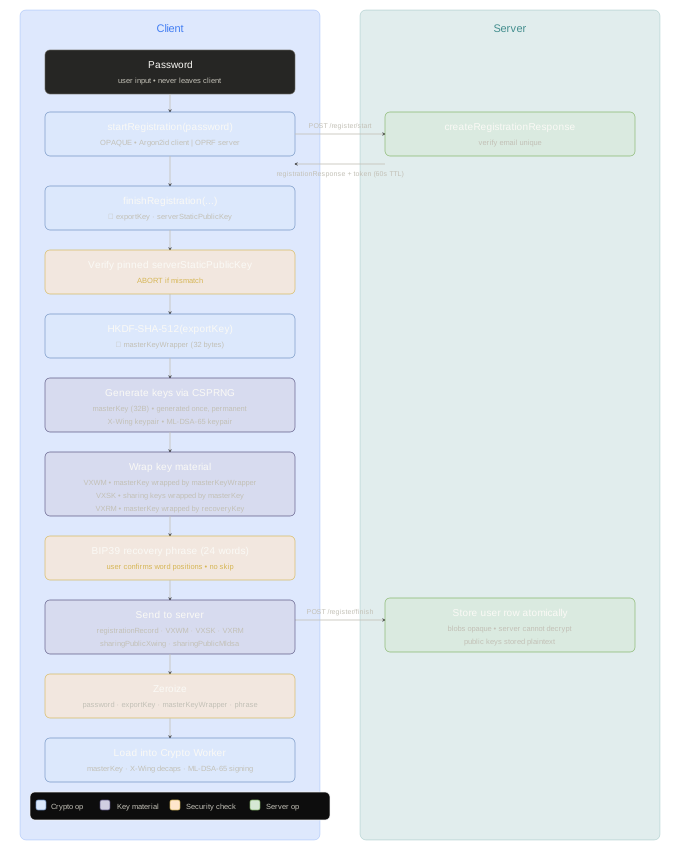
3.2 What Gets Created at Registration
| Item | How | Stored where | Server can read? |
|---|---|---|---|
registrationRecord | OPAQUE output | Server (DB) | No (opaque envelope) |
masterKey | CSPRNG (32 bytes) | Server as VXWM (wrapped) | No |
VXWM blob | masterKey encrypted with masterKeyWrapper | Server (DB) | No |
VXRM blob | masterKey encrypted with recoveryKey | Server (DB) | No |
| X-Wing keypair | CSPRNG | Decaps key in VXSK; encaps key plaintext on server | Public key only |
| ML-DSA-65 keypair | CSPRNG | Signing key in VXSK; verify key plaintext on server | Public key only |
VXSK blob | Sharing private keys encrypted with masterKey | Server (DB) | No |
| Recovery phrase | BIP39 (256-bit entropy) | Shown once, never stored | Never |
3.3 What the Server Stores (Users Table)
CREATE TABLE users (
    id                       UUID PRIMARY KEY DEFAULT gen_random_uuid(),
    email                    CITEXT UNIQUE NOT NULL,
    locale                   TEXT NOT NULL DEFAULT 'en',
    opaque_protocol_version  SMALLINT NOT NULL DEFAULT 1,
    registration_record      BYTEA NOT NULL,        -- OPAQUE envelope
    vxwm                     BYTEA NOT NULL,        -- wrapped masterKey (password)
    vxrm                     BYTEA NOT NULL,        -- wrapped masterKey (recovery)
    vxsk                     BYTEA NOT NULL,        -- wrapped sharing keys
    sharing_public_xwing     BYTEA NOT NULL,        -- 1216 bytes, plaintext
    sharing_public_mldsa     BYTEA NOT NULL,        -- ~1952 bytes, plaintext
    reset_generation         INTEGER NOT NULL DEFAULT 0,
    created_at               TIMESTAMPTZ NOT NULL DEFAULT now(),
    updated_at               TIMESTAMPTZ NOT NULL DEFAULT now()
);
3.4 Key Derivation at Registration

4. Login
Login reconstructs the session-time key material from the user's password and the blobs stored on the server. No permanent key material changes during login.
The masterKey is unwrapped and loaded into the Crypto Worker, then discarded from memory on logout or timeout.
4.1 Full Login Flow
See diagram in the rendered documentation. Steps: user input -> OPAQUE exchange -> pin verification ->
masterKeyWrapperderivation ->VXWM/VXSKunwrap ->POST /login/finish-> session cookie -> zeroize -> Crypto Worker load.
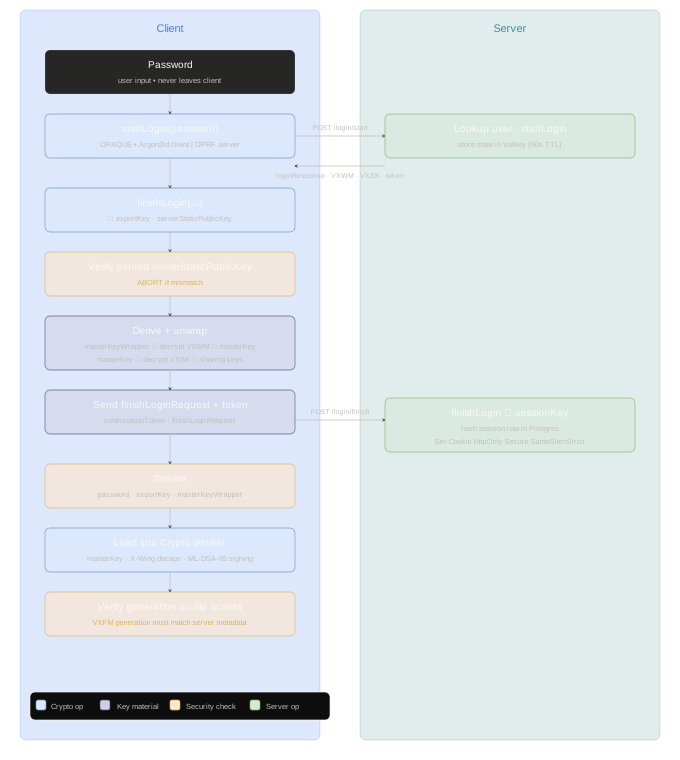
4.2 What Gets Reconstructed at Login
Nothing permanent is created at login. The following are derived transiently from the correct password and discarded when the session ends:
| Item | Derived from | Lives where | Discarded when |
|---|---|---|---|
exportKey | OPAQUE exchange | Client memory only | Immediately after masterKeyWrapper derivation |
masterKeyWrapper | HKDF(exportKey) | Client memory only | Immediately after unwrapping masterKey |
masterKey | Unwrapped from VXWM | Crypto Worker only | Session timeout / logout |
| X-Wing decaps key | Unwrapped from VXSK via masterKey | Crypto Worker only | Session timeout / logout |
| ML-DSA-65 signing key | Unwrapped from VXSK via masterKey | Crypto Worker only | Session timeout / logout |
sessionKey | OPAQUE exchange | Used to mint cookie, then zeroized | Immediately |
4.3 Key Derivation at Login

The exportKey is stable: as long as the password is the same and serverSetup has not changed, the same 64-byte value emerges from every login. This is how the server can store the wrapped masterKey once and have it be unwrappable on every future login without the server ever knowing the wrapping key.
4.4 Session Cookie
The server derives an HTTP session token from sessionKey and stores a SHA-256 hash of it in the database. The raw token is returned to the client as a cookie. Cookie attributes:
HttpOnly; Secure; SameSite=Strict; Path=/Absolute lifetime: 24 hours, renewed on activity. The raw sessionKey is zeroized on both client and server immediately after the cookie is issued. The server never stores it.
5. Session Management
5.1 Active Session (Default)
Once logged in, the masterKey and sharing private keys live exclusively inside a dedicated Crypto Web Worker. They never touch the main JavaScript thread's heap.
The Worker exposes only operation endpoints. It never returns raw key material:
| Worker endpoint | What it does |
|---|---|
encryptFileSegment | Returns ciphertext |
decryptFileSegment | Returns plaintext segment |
deriveCollectionKey | Returns encrypted operation result |
wrapForSharing | Returns VXSH blob (includes "p" permission field) |
unwrapFromSharing | Returns operation result; never returns raw key material |
Inactivity timeout: 30 minutes. The Worker is terminated and all in-memory key material is zeroized. The user must re-authenticate. Closing the browser tab has the same effect.
5.2 Persistent Session - "Remember Me" (opt-in only)
Never enabled by default. When opted in, a device-bound blob lets the user resume without re-entering their password.
Activation:
1. Client generates localKey (32 random bytes, CSPRNG)
2. Client encrypts masterKey with localKey -> VXPS blob // (see CRYPTO.md §5.6)
3. Client stores localKey in IndexedDB
4. Client -> Server: POST /auth/persistent-session/create { vxps, deviceLabel }
   // Implementation note: if the client crashes between step 3 and step 4,
   // localKey is orphaned in IndexedDB. Harmless: absence of PS-AUTH cookie
   // causes it to be silently ignored. MAY be GC'd on startup.
5. Server stores { userId, vxps, cookieHash, deviceLabel, createdAt, expiresAt }
6. Server issues PS-AUTH cookie (HttpOnly; Secure; SameSite=Strict; Max-Age=30d)
Resume:
1. Client detects PS-AUTH cookie AND localKey in IndexedDB
   // If PS-AUTH present but localKey absent (storage cleared): silently discard,
   // show password form. Server-side session remains valid until expiry or revocation.
2. Client shows "Resume as <user>" prompt (no password form)
3. Client -> Server: GET /auth/persistent-session/resume (cookie auto-attached)
4. Server validates cookie, returns { vxps, vxsk }
5. Client retrieves localKey from IndexedDB, decrypts VXPS -> masterKey -> loaded into Worker
6. Server issues fresh active-session cookie alongside the persistent one
Revocation:
- Logout: client deletes
localKeyfrom IndexedDB +DELETE /auth/persistent-session/{id} - Sign out everywhere: client clears IndexedDB + server wipes all
persistent_sessionsfor the user - Password change: server wipes all
persistent_sessions; client must re-activate "Remember me"
Security trade-off (displayed at opt-in):
Remember me stores an encrypted copy of your master key on VexaHub servers (
VXPSblob), and the decryption key (localKey) on this device inIndexedDB. Neither side alone is sufficient to recover your data.An attacker who simultaneously gains full control of VexaHub servers and captures your
PS-AUTHsession cookie and reads your device'sIndexedDBcould decrypt this remembered session. Under normal operation your data remains private.For strict zero-knowledge guarantees, leave Remember me unchecked and authenticate with your password each session. Desktop and mobile clients achieve zero-knowledge persistent sessions via OS keychain. The server holds no key material in either case.
Zero-knowledge tiers:
| Mode | True ZK? | Server holds |
|---|---|---|
Web (no Remember me) | ✅ Yes | Nothing session-side |
Web (Remember me) | ⚠️ Trade-off (opt-in, documented) | vxps (encrypted blob) |
Web (Remember me + WebAuthn PRF) | ✅ Yes | Nothing |
| Desktop / Mobile | ✅ Yes | Nothing |
Mandatory safeguards:
- Strict opt-in only. No nudging.
- Settings page lists every persistent session with device label, creation time, last use, and one-click revoke.
- Password change revokes all persistent sessions server-side.
- Server-side inactivity timeout: session deleted after 30 days of disuse.
- "Sign out everywhere" wipes all server-side persistent sessions and the local IndexedDB
localKey. localKeyis never stored client-side in plaintext beyond the instant it is used to decrypt theVXPSblob.
5.3 Session Database Schema
CREATE TABLE sessions (
    id           UUID PRIMARY KEY,
    user_id      UUID NOT NULL REFERENCES users(id) ON DELETE CASCADE,
    cookie_hash  BYTEA NOT NULL,           -- SHA-256 of the cookie value
    created_at   TIMESTAMPTZ NOT NULL DEFAULT now(),
    last_used_at TIMESTAMPTZ NOT NULL DEFAULT now(),
    expires_at   TIMESTAMPTZ NOT NULL,
    revoked_at   TIMESTAMPTZ,
    user_agent   TEXT,
    ip_network   CIDR                      -- /24 IPv4 or /48 IPv6, host bits zeroed at insert
);

CREATE TABLE persistent_sessions (
    id           UUID PRIMARY KEY,
    user_id      UUID NOT NULL REFERENCES users(id) ON DELETE CASCADE,
    vxps         BYTEA NOT NULL,
    cookie_hash  BYTEA NOT NULL,
    device_label TEXT NOT NULL,
    created_at   TIMESTAMPTZ NOT NULL DEFAULT now(),
    last_used_at TIMESTAMPTZ NOT NULL DEFAULT now(),
    expires_at   TIMESTAMPTZ NOT NULL,
    revoked_at   TIMESTAMPTZ
);

CREATE INDEX ON sessions (user_id) WHERE revoked_at IS NULL;
CREATE INDEX ON persistent_sessions (user_id) WHERE revoked_at IS NULL;
6. Account Recovery
6.1 Recovery Phrase (Non-Destructive)
At registration a 24-word BIP39 phrase (256 bits of entropy) is generated and used to produce a second wrapped copy of masterKey. This means forgetting a password does not mean losing all data.
seed        = BIP39.mnemonicToSeed(phrase, passphrase = "")
recoveryKey = HKDF-SHA-512(
    ikm  = seed,
    salt = 32 zero bytes,
    info = "vexahub:v1:recoveryKey:{user_uuid}",
    L    = 32
)
HKDF rather than Argon2id is used here because the BIP39 phrase already provides 256 bits of entropy. Memory-hardening would add latency with no meaningful security gain.
The phrase is shown once at registration, never stored client-side, never transmitted to the server. The user confirms specific word positions before registration completes. There is no skip option.
Recovery flow (password forgotten, phrase available):
- User enters email + recovery phrase
- Client -> Server:
GET /auth/recovery/lookup?email={email}(rate-limited) <- { vxrm, user_uuid } - Client re-derives
recoveryKeyfrom phrase + user_uuid - Client decrypts
VXRM->masterKey(samemasterKeyas always) - User chooses a new password
- Client runs a fresh OPAQUE registration with the new password
- Client re-wraps
masterKeywith the newmasterKeyWrapper-> newVXWM - Client -> Server:
POST /auth/recovery/finish{ registrationRecord, vxwm, vxsk } (atomic replace) - All existing files, collections, and shares remain valid.
masterKeynever changed
6.2 Destructive Reset
When both password and recovery phrase are lost. Triggered only via an email-confirmed link. Displays an explicit data-loss warning, then atomically wipes all files and rotates all key material under a new reset_generation. There is no way back from this path.
6.3 Phrase Rotation
From settings, an authenticated user can regenerate their recovery phrase. The new phrase wraps the existing masterKey; the old VXRM is replaced atomically. The masterKey itself does not change, so no file re-encryption is needed.
7. Key Material Quick Reference
What exists only at registration
| Item | Notes |
|---|---|
masterKey | Generated once via CSPRNG. Never regenerated unless destructive reset. |
| X-Wing keypair | Permanent. Decaps key wrapped in VXSK. |
| ML-DSA-65 keypair | Permanent. Signing key wrapped in VXSK. |
VXWM blob | Wrapped masterKey keyed to the password. Replaced on password change. |
VXRM blob | Wrapped masterKey keyed to the recovery phrase. |
VXSK blob | Wrapped sharing keypair. Re-wrapped on password change. |
| Recovery phrase | Shown once. Never stored anywhere. |
What exists only during a session
| Item | Origin | Discarded |
|---|---|---|
exportKey | OPAQUE output | Immediately after masterKeyWrapper derivation |
masterKeyWrapper | HKDF(exportKey) | Immediately after unwrapping masterKey |
sessionKey | OPAQUE output | Immediately after cookie is issued |
masterKey (live) | Unwrapped from VXWM | Session timeout / logout / tab close |
| X-Wing decaps key (live) | Unwrapped from VXSK | Session timeout / logout / tab close |
| ML-DSA-65 signing key (live) | Unwrapped from VXSK | Session timeout / logout / tab close |
What the server knows vs does not know
| Server knows | Server never knows |
|---|---|
| Email address | Password (or any hash of it) |
OPAQUE registrationRecord (opaque envelope) | exportKey |
VXWM, VXRM, VXSK blobs (ciphertext only) | masterKeyWrapper |
| X-Wing encapsulation key (public) | masterKey |
| ML-DSA-65 verification key (public) | collectionKey, fileKey |
| Session cookie hash | File content, file names, mime types |
vxps blob (persistent sessions only) | Recovery phrase |
| File/collection UUIDs, ciphertext sizes, timestamps | Any plaintext metadata |